
Date
Wed Jul 8A single roof leak during a Pacific Northwest storm can cause thousands of dollars in water damage overnight. Heavy rains in Seattle turn a small shingle gap into a costly mess that affects your walls, insulation, and framing within hours. Getting professional help on-site is the best way to stay dry.
Facing a roof leak right now? Call 1-855-908-7663 for same-day emergency tarping in Seattle if you call before noon.
Finding water dripping into your home is stressful, but a measured response limits the damage before the roofing crew arrives. Below we cover exactly what to do, what Seattle’s unique climate means for your roof. How professional tarping works, and what the full repair process looks like from first call to final warranty.
Emergency Roof Repair Seattle: What to Do Immediately When You Find a Roof Leak
A roof leak in Seattle requires immediate action to prevent structural damage and mold growth. First, place buckets under active drips and move furniture away from the wet area. If you see a ceiling bulge, poke a small hole to drain trapped water safely. Take photos for your insurance claim, then call a licensed local roofer for same-day emergency tarping before the next storm cell arrives.
A roof leak is a true crisis for any home in the Seattle area. When water drips into your house, it can lead to mold and rot fast. You must act quickly to stop the harm from spreading to other rooms. To keep your home safe, start with these steps to catch the water and find where it comes from.
Control the water inside your home
The first task is to catch the drips before they ruin your floors or walls. Place a bucket or large pot under every active leak. If water splashes, put an old towel in the bottom of the pot to dampen the spray. Move chairs, electronics, and rugs away from the wet area. For heavy furniture you cannot move, cover it with a plastic sheet.
A leaking roof is a serious risk because moisture trapped inside wall cavities can rot the framing of your home. If you see a bulge in your ceiling, water has pooled above the drywall. Carefully poke a small hole at the center of that bulge with a screwdriver or awl. This lets the water drain into your bucket and prevents the ceiling from collapsing under the weight. Watch for light fixtures or electrical wires near any wet areas and avoid contact.
Document the damage for your insurance claim
Before you clean anything up, take photos and video of the leak from multiple angles. Show where the water entered and the damage it caused to ceilings, walls, floors, and personal belongings. This visual evidence is critical when you file your homeowners insurance claim later. Keep a written list of every item that got wet or was damaged. Detailed documentation speeds up claim processing and helps ensure you receive proper coverage for your emergency roof repair cost.
- Set out buckets: Place containers under every drip to catch water immediately and prevent floor damage.
- Move your belongings: Shift furniture and rugs away from the leak or cover them with plastic sheeting.
- Drain ceiling pockets: Poke a small hole in sagging ceiling areas to release trapped water safely into a bucket.
- Turn off HVAC: Shut down your heating and air system if the leak is near a vent to prevent water from spreading through ductwork.
- Take clear photos: Record all signs of the leak and resulting damage to walls, floors, and personal property.
- Stay off the roof: Do not climb onto your roof during a storm. Wet shingles are dangerously slippery and the risk of falls is high.
- Call a professional: Contact a local licensed roofer for emergency roof repair Seattle service to install a temporary barrier before the next storm.
Get expert help quickly
Once you have the interior water under control, you need a professional roofing contractor to assess the exterior damage. Climbing onto a wet roof without proper safety harnesses and fall protection equipment is one of the leading causes of home-injury accidents during storms. A licensed contractor has the training, ladder equipment, and safety gear to inspect your roof safely even in wet conditions.
Most local roofing companies offer a free on-site inspection to evaluate the extent of the damage. The inspector will examine your shingles, flashing, vents, and valleys to locate every entry point. If rain is still falling. The crew can install a heavy-duty tarp as a temporary barrier to keep water out until the storm passes and permanent repairs can be scheduled. Acting within the first 24 hours of a leak is the single most effective way to minimize total repair costs.
Why Seattle’s Climate Makes Emergency Roof Repairs Urgent
Seattle receives approximately 38 inches of rain annually, and the Pacific Northwest’s extended wet season means roofs rarely dry out completely between storms. This continuous moisture exposure accelerates deterioration, promotes moss growth that traps water against shingles, and turns minor leaks into major structural issues within days. Freeze-thaw cycles during winter further widen existing cracks.
Seattle is known for its grey skies and steady rain. The city sees about 38 inches of rainfall each year, spread across nine months of the wet season. This persistent wet weather puts extraordinary stress on local roofing systems. Unlike drier climates where a roof gets a chance to dry out between rain events, a roof in the Pacific Northwest stays damp for weeks at a time. This environment makes it easy for a small drip to escalate into a major repair. You may need immediate emergency roof repair services to stop leaks before they grow.
Heavy rainfall and hidden water damage
The primary risk for Seattle homeowners is the sheer volume of rain that falls between October and March. When a leak starts, water follows gravity down into your attic, along wall studs, and eventually into insulation and drywall. This hidden moisture can ruin your insulation’s R-value and rot wooden framing members within days. Several factors compound this risk:
- Back-to-back storm systems that leave no drying window between events.
- Wind-driven rain that pushes moisture horizontally under loose or lifted shingles.
- Consistent high humidity that slows natural evaporation inside attic spaces.
The Environmental Protection Agency emphasizes that moisture control is a critical component of healthy home maintenance. As standing water and damp building materials promote mold colonization and structural decay. Delaying repairs allows water to wick far from the original entry point, substantially increasing both the scope and cost of the fix.
Moss growth and freeze-thaw cycles
The damp Pacific Northwest climate creates ideal conditions for moss growth on roofing surfaces. While moss may appear rustic or charming, it is structurally destructive. Moss acts like a sponge, holding moisture against your shingles for extended periods. This prevents the roof from shedding water as designed. When winter temperatures drop below freezing, the water trapped within the moss and under lifted shingle edges turns to ice. Ice expands by roughly 9 percent, prying shingles loose and widening existing cracks. This freeze-thaw cycle repeats every cold snap, progressively worsening damage until the roof fails completely.
Atmospheric rivers and intense winter storms
In recent years, the Puget Sound region has experienced an increase in the frequency of atmospheric river events. These storms carry immense amounts of moisture from the tropical Pacific and release it as prolonged heavy rain accompanied by high wind gusts. These winds can strip away roofing materials, send debris airborne, and topple tree limbs onto houses. Once the outer roofing layer is breached, rain pours directly into the home. Landmark Roofing & Siding’s local crews understand these specific weather patterns and maintain rapid-response readiness to secure your home before the next storm cell arrives.
How Emergency Roof Tarping Protects Your Home
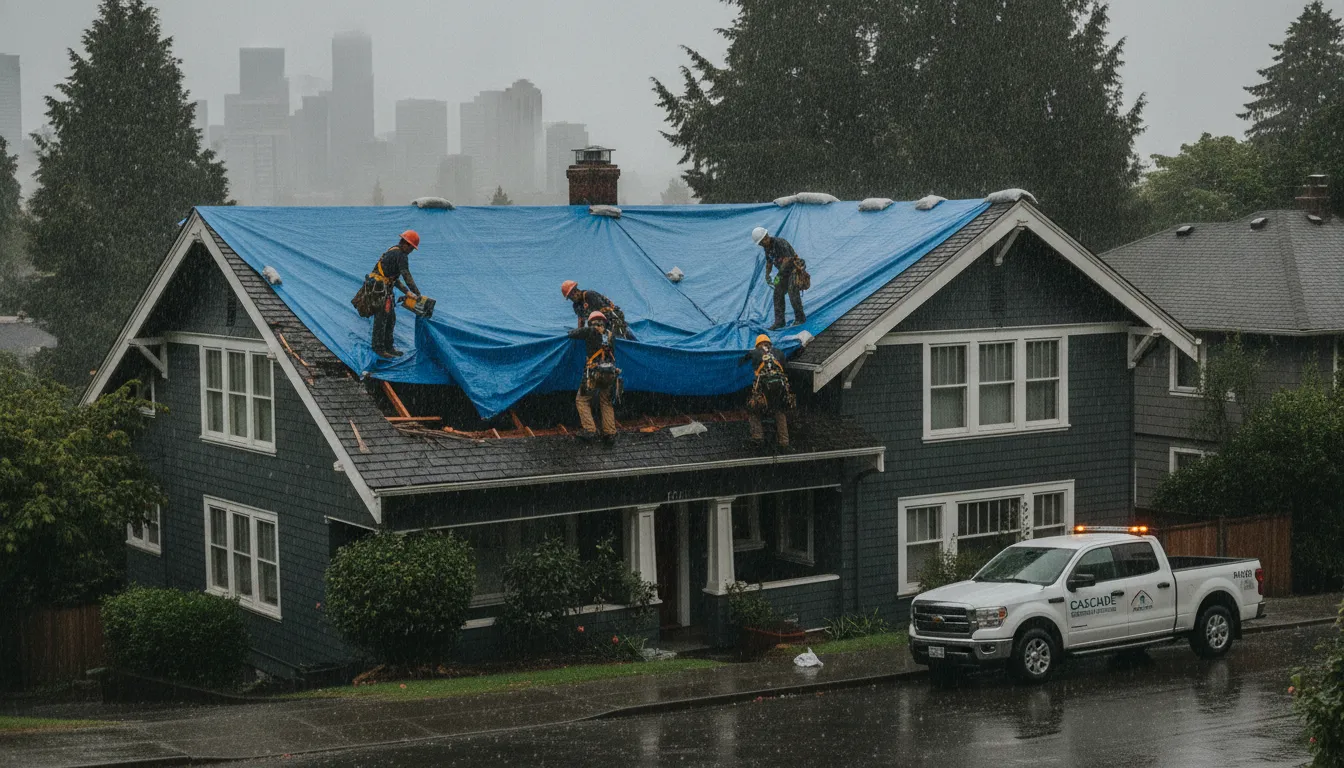
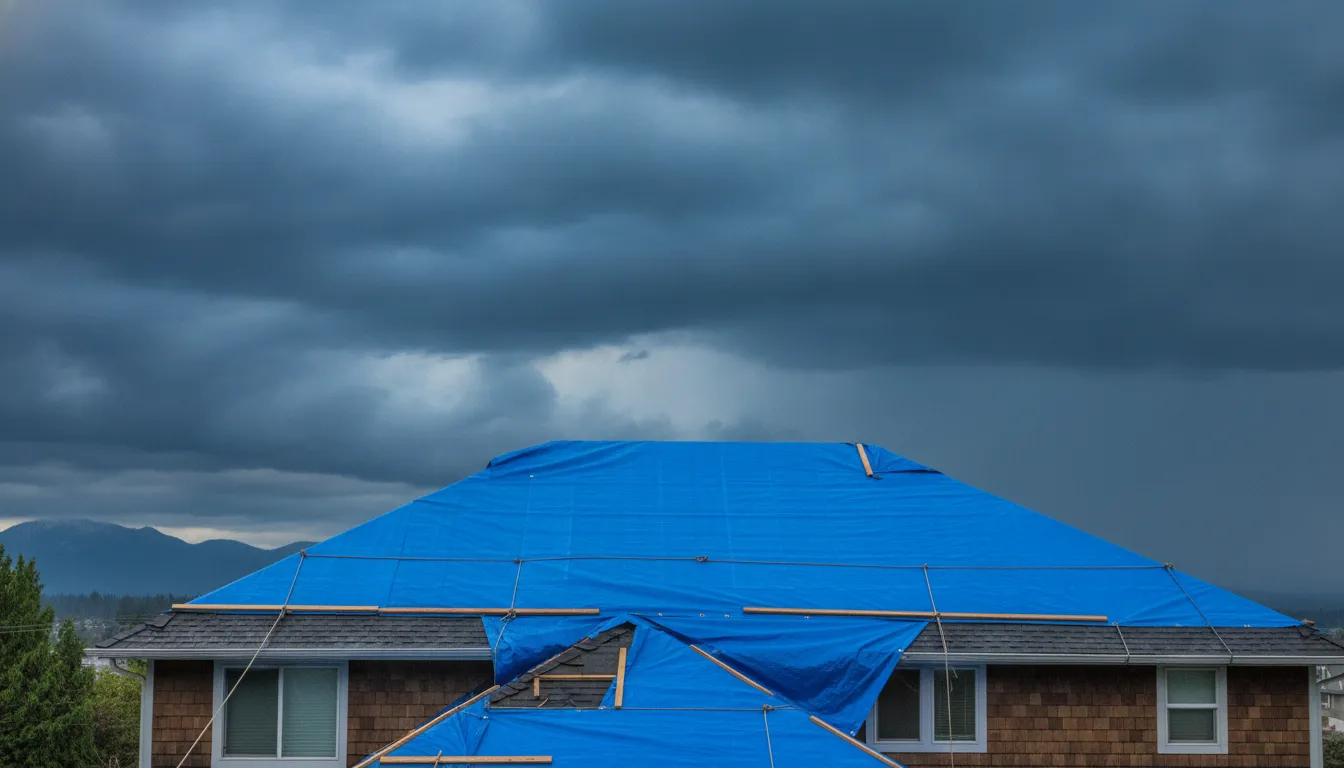
Professional emergency roof tarping uses industrial-grade reinforced polyethylene tarps secured with wooden batten strips and cap nails, creating a watertight seal that withstands Pacific Northwest wind and rain. Unlike a hardware-store blue tarp held down with bricks, a professionally installed tarp stays in place through storms and prevents further water intrusion until permanent repairs are completed.
When a storm damages your roof, every hour of delay allows more water to enter your home. A hole or tear in the roofing membrane lets rain pour into the attic, saturating insulation and soaking ceiling drywall. Professional roofers use heavy-duty tarps as an immediate weather barrier. This is a short-term shield, but it is the most effective way to stop ongoing damage while you plan permanent repairs.
How professional tarping differs from DIY solutions
Not all tarps are equal. A lightweight blue tarp from a big-box store can tear in moderate wind and may abrade against rough shingle edges overnight. Seattle winter storms routinely bring sustained winds of 30 to 45 miles per hour, which will shred a poorly secured tarp. Landmark Roofing & Siding uses industrial-grade reinforced polyethylene tarps that are thick, UV-resistant, and puncture-resistant. Our crews do not place bricks on corners. Instead, they install wooden furring strips along the tarp edges and drive cap nails through both the strip and tarp into the roof deck. This creates a mechanically fastened seal that stays tight regardless of wind direction.
Same-day service and tarping credits
Speed is essential when you need emergency roof repair Seattle services after a storm. Most roofing companies can deploy a tarp crew within 24 hours of your call. Landmark Roofing & Siding aims to move faster. If you call before noon, our team offers same-day emergency tarping to seal your roof before nightfall. Waiting even one additional day can allow mold colonies to establish in damp attic insulation and wall cavities.
We also apply your tarping fee as a credit toward your permanent repair invoice. This means the cost of the temporary protection is not an extra expense. When you choose Landmark Roofing & Siding for the full repair, the tarping cost is deducted from your final bill. You get immediate protection now and pay less later for the permanent fix.
The professional tarping process
When our crew arrives at your home, we work methodically. First, we inspect the entire roof to identify all damaged areas, not just the spot where water is actively leaking. We look for lifted shingles, punctures from fallen branches, cracked flashing, and missing ridge caps. Next, we measure and cut the reinforced tarp to overlap the damage zone by at least three feet on all sides. We then secure the tarp with wooden batten strips and ring-shank cap nails driven into solid roof decking. The result is a watertight barrier engineered to withstand Seattle weather until permanent repairs are scheduled.
- Industrial-grade reinforced tarps rated for PNW storm conditions
- Wooden batten strips prevent wind uplift and edge tearing
- Direct staff employees, not subcontractors , same crew from inspection through repair
- Full debris removal and magnetic nail sweep after every job
What to Expect When You Call for Emergency Roof Repair
When you call Landmark Roofing & Siding for an emergency roof leak, you speak directly with a local dispatcher who sends a licensed crew to your home. The process includes a free on-site inspection with photo documentation for insurance, same-day tarping if needed. And a permanent repair plan typically scheduled within 48 hours of the initial call.
A sudden roof leak during a storm can feel overwhelming. But the path from first call to dry home is straightforward when you work with an established local contractor. Landmark Roofing & Siding makes the process transparent from the first ring.
Your first call and rapid crew deployment
When you call our team, you reach a local dispatcher who can mobilize a crew immediately. We provide 24/7 emergency service because roof leaks do not respect business hours. The dispatcher gathers your address, a brief description of the leak location and severity, and then routes the nearest available crew to your property. Every technician we send is a direct employee of Landmark Roofing & Siding, fully licensed (LANDMRS880BS), insured, and bonded. You are never working with a subcontractor or day-labor crew whose training and work quality are unknown.
The free on-site damage assessment
Upon arrival, our lead technician performs a comprehensive inspection of your roof. This includes examining the roof surface, flashing and penetrations, the attic interior, and the ceiling damage inside your home. We identify every entry point, not just the most obvious one. During the assessment, we also document the damage with high-resolution photos and written notes that support your insurance claim. Having a professional assessment with timestamped photographic evidence streamlines the claims process with your carrier and helps ensure you receive appropriate coverage for the full scope of repairs.
Tarping and permanent repair scheduling
If we can stop the leak with tarping on the same visit, we do so. For calls received before noon, we guarantee same-day tarping to keep rain out overnight. For calls after noon, the crew will secure the roof with a temporary patch and return first thing the next morning for full tarping. Once the tarp is installed, we schedule permanent repairs within 48 hours. This rapid timeline means your home spends minimal time under a temporary cover. We use premium materials suited to Seattle’s wet climate and provide a lifetime craftsmanship warranty on all completed repairs.
How Much Does Emergency Roof Repair Cost in Seattle?
Emergency roof repair in Seattle typically costs between $300 and $800 for tarping alone. With partial shingle repairs ranging from $500 to $1,500 and full replacements starting at $10,000. Landmark Roofing & Siding offers free on-site inspections with written estimates and applies the tarping fee as a credit toward permanent repairs.
Cost is a primary concern for most homeowners facing an unexpected roof emergency. The final price depends on the extent of the damage, the roofing material, the pitch of the roof, and whether structural elements have been affected. Landmark Roofing & Siding provides free on-site inspections with a clear, written price quote before any work begins.
Factors that influence repair pricing
The type of roofing material on your home is the largest variable. Asphalt composition shingles are the most common in Seattle and the most economical to repair. Metal panels, cedar shakes, clay tiles, and synthetic slate each require specialized materials and installation techniques that increase cost. Roof pitch also matters. Steeper roofs require additional safety equipment and take longer to work on, increasing labor time. If water has penetrated to the roof deck or structural framing, repairs expand beyond the surface layer.
Typical cost scenarios for Seattle homes
The table below shows representative cost ranges for common emergency roof repair scenarios on a typical 1,500-square-foot Seattle home with asphalt composition shingles. Landmark Roofing & Siding offers 0% APR financing with terms from 24 to 240 months to help manage unexpected expenses.
| Service Type | Estimated Cost Range | Timeline |
|---|---|---|
| Emergency Tarp Only | $300 – $800 | Set up within 24 hours |
| Partial Shingle Repair | $500 – $1,500 | Scheduled within 48 hours |
| Full Roof Replacement | $10,000 – $25,000+ | Depends on size and material |
Installing a temporary tarp within the first 24 hours is the most cost-effective step you can take. It prevents the exponential cost escalation that occurs when water spreads to insulation, drywall, electrical systems, and structural framing. Landmark Roofing & Siding credits the full tarping fee toward your permanent repair, making the initial emergency response effectively free when you move forward with the complete fix.
From Temporary Tarp to Permanent Roof Repair
The transition from emergency tarping to permanent roof repair follows a six-step process: emergency tarping. Professional damage inspection, insurance claim documentation, material selection, scheduled permanent repair, and warranty activation. Landmark Roofing & Siding manages every step with direct employees, ensuring consistent quality from first response to final cleanup.
When your roof leaks in the Puget Sound region, immediate tarping stops the active water intrusion. But a tarp is a temporary solution, not a permanent fix. Following a clear path from emergency response to completed replacement ensures your home is fully protected for the long term. Landmark Roofing & Siding handles every stage with a single point of contact so you never have to coordinate between separate companies.
The complete repair sequence
1. Emergency response and tarping. Our crew arrives at your home with industrial-grade tarps and installation materials. We secure the damaged area with batten strips and cap nails to create a watertight seal that withstands wind and rain. This stops active water intrusion immediately.
2. Professional damage inspection. After tarping, our lead inspector performs a thorough evaluation of your entire roofing system. We document every compromised shingle, flashing gap, and structural concern and provide a detailed written report with photographs.
3. Insurance claim support. We compile our inspection documentation into a claims-ready package including photos, material estimates, and a scope-of-work narrative. This package makes filing with your insurance carrier faster and more likely to cover the full cost of necessary repairs.
4. Material selection and proposal. You choose the replacement materials that match your home’s style and budget. We offer premium brands including CertainTeed, Malarkey, DaVinci Roofscapes, and Nu-Ray metal roofing. Our project advisor walks you through each option’s durability, warranty coverage, and aesthetic profile.
5. Scheduled permanent repair. We schedule your permanent roof repair within 48 hours of tarping. Our direct-employment crews handle the complete tear-off of damaged materials, deck repair if needed, new underlayment and flashing installation, and the final roofing layer.
6. Cleanup and warranty activation. After installation, we perform a magnetic sweep of the entire property to collect every stray nail and piece of debris. We then activate your lifetime craftsmanship warranty and manufacturer material warranties, giving you long-term protection on the completed work.
Choosing the right materials for Seattle’s climate
A permanent roof repair in Seattle requires materials engineered for continuous moisture exposure, wind-driven rain, and freeze-thaw cycles. Landmark Roofing & Siding helps you select from impact-resistant asphalt shingles, standing-seam metal panels, and premium synthetics that outperform standard builder-grade options in Pacific Northwest conditions. Because we handle everything from the first tarp to the final cleanup, you have one team responsible for quality from start to finish.
Frequently Asked Questions
Is a leaking roof an emergency?
Yes. A leaking roof is an emergency because water can cause structural damage, rot wooden framing, and promote mold growth within 24 to 48 hours. The Environmental Protection Agency recommends drying all building materials quickly to prevent mold colonization. If you see active dripping or ceiling staining, call a licensed roofer immediately.
How quickly can you install an emergency roof tarp in Seattle?
Landmark Roofing & Siding offers same-day emergency tarping for calls received before noon. Calls placed after noon receive next-morning priority service, with a guaranteed tarp install within 24 hours. Permanent repairs are typically scheduled within 48 hours of the initial tarp installation.
How much does emergency roof repair cost in Seattle?
Emergency tarping typically costs $300 to $800, partial shingle repairs run $500 to $1,500. And full roof replacements range from $10,000 to $25,000 or more depending on roof size and material. Landmark Roofing & Siding offers free on-site estimates and applies the tarping fee as a credit toward permanent repairs. We also provide 0% APR financing options with terms from 24 to 240 months to help homeowners manage unexpected expenses.
Can I get emergency roof repair service 24/7 in Seattle?
Yes. Landmark Roofing & Siding provides 24/7 emergency response for storm damage and roof leaks throughout the Seattle area. Our crews are licensed (LANDMRS880BS), insured, and employed directly by our company. You can call anytime day or night, including weekends and holidays, and we will dispatch a crew to secure your home.
How soon should I schedule permanent roof repair after emergency tarping?
Permanent repairs should be scheduled as soon as possible. A tarp is a temporary barrier designed to hold for a few weeks at most. Landmark Roofing & Siding schedules permanent repairs within 48 hours of tarp installation to minimize the time your home spends under temporary coverage and to prevent secondary damage from developing.
Ready to Stop Your Roof Leak Today?
Delaying roof leak repair allows water to rot structural framing, ruin insulation, and create mold hazards that threaten your family’s health. Every hour you wait, the damage spreads farther from the original leak point and the repair cost increases. Landmark Roofing & Siding’s local Seattle crews can reach your home today to install a professional-grade tarp that stops water intrusion immediately.
Call before noon for guaranteed same-day service. 1-855-908-7663. Our fully licensed and insured team is on standby 24/7 to handle your emergency with professional speed and care. We apply your tarping fee as a credit toward permanent repairs. And we schedule the final fix within 48 hours so your roof is fully restored before the next storm arrives.